
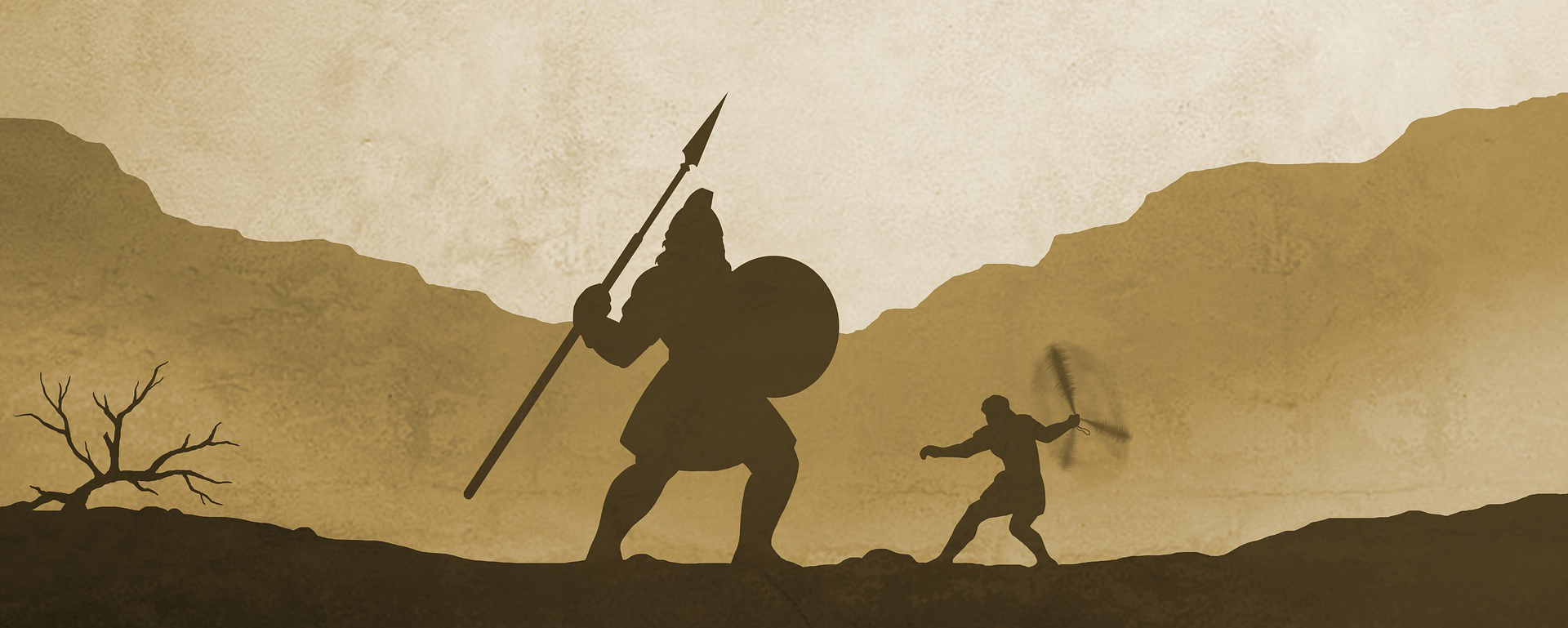
Be the hero of your own story. That’s kind of how we’re encouraged to look at life today. The idea that if you believe in something strongly enough, if you’re willing to put yourself out there and take risks, you can make things happen in your life — whether it’s in the business world, your relationships, your own sense of well-being. You can achieve your goals, and people are going to see it and acknowledge your success.
There’s something appealing in the idea of beating the odds, overcoming obstacles, proving people wrong, and standing vindicated for all to see. We can all relate to it — at least we can relate to feeling as if we’re the one with the odds stacked against us. And when we see someone prevailing over difficulty, it makes us feel like we can do it too, against whatever it is that we’re facing in our own lives.
David and Goliath
The Bible is filled with stories like that – or at least stories that seem to fit that description, and the one that seems to stand out the most is the story of David and Goliath. It is a story so striking, so astonishing, that it literally became a cliché. When David faced down and toppled the giant, he became the inspiration for underdogs and long-shots throughout history.
We see a former shepherd turning into the hero of a nation, with the women of Israel singing songs of praise about him, even outshining the king. He became the symbol of a nation — and still is today. But I think it’s easy sometimes to miss the message, particularly in a culture where we tend to make everything about “us.”
When we see this story referenced today, particularly in more secular contexts, it tends to focus on self-confidence and trust, not being intimidated just because the obstacle looks imposing. It focuses on the idea of a long-shot winning against the odds. We use this story to explain why tiny colleges often send undermanned teams into a game and upset clearly superior teams with better resources and athletic skill. We usually use terms like “on any given day,” and “this was that one time out of 10 where they overcame the odds.” As if David might not have fared so well in the rematch.
And so we are taught to have faith and take our swing, because it might just be our day. Plenty of others tried and failed, but we could be the ones who succeed!
Who is the true hero in David’s story?
Except there’s more to that story, as any Bible school student will tell you. Because in reality, David isn’t the true hero of this story — at least not in the sense that he gathers some inner strength and resolve, trusts his training, and through his own skill and determination takes down the stronger opponent.
Before killing Goliath, David stands before him and tells him:
“You come to me with a sword and with a spear and with a javelin, but I come to you in the name of the LORD of hosts, the God of the armies of Israel, whom you have defied. This day the LORD will deliver you into my hand, that all the earth may know that there is a God in Israel, and that all this assembly may know that the LORD saves not with sword and spear. For the battle is the LORD’s, and he will give you into our hand.”
Why was David this confident? Because God had made a promise to the people of Israel – not to David, personally, but to God’s people as a whole — that if they would go into the land of Canaan, God would fight their battles. He would defeat their enemies. And when Israel remained faithful to God, God gave them victory after victory.
David doesn’t see himself as an underdog, because he is NOT the underdog. David beats Goliath 10 times out of 10. 100 out of 100. Because David is not called to overcome anything. God is with him. And because of that, Goliath never had a chance.
Why did David beat Goliath?
There’s a key statement in David’s taunt to Goliath that is important, and often goes unnoticed.
“The battle is the Lord’s.”
David won because he was fighting God’s battle. Not because God was helping him win his own battle.
We often think of stories like this as an example of God helping his people accomplish their goals, cheering us on, glorying in our individual accomplishments. We go to passages like Philippians 4:13 where Paul says “I can do all things through him who strengthens me,” and we apply that to anything from winning an athletic contest to succeeding in school to getting a promotion at work.
But as it turns out, we lose a lot. We fail a lot. We suffer loss. And we ask “Why isn’t God taking care of me? Why has he let me down?” And David had his share of those moments as well.
Some 300 years later, the kingdom of Judah was ruled by a man named Josiah, who is described this way:
Before him there was no king like him, who turned to the LORD with all his heart and with all his soul and with all his might, according to all the Law of Moses, nor did any like him arise after him.
Josiah was a great king and God was with him. And yet, Josiah died in battle, because he rode out to fight against the Egyptians. He picked a fight because he was certain God was on his side and that God would give him victory. Except it wasn’t God’s will for Josiah to fight that battle. Josiah did it on his own, whether it was to end a perceived threat to his people, to defeat the army of a nation whose idolatry was an affront to God, or maybe just to fuel his own personal pride. We aren’t told, but we do see that despite being a righteous king, Josiah fails, and dies as a result of that fight. Because God didn’t go with him – even though Josiah was a good king and loved God.
Fighting God’s battles, not our own
The story of David isn’t that God will give us victory in whatever we do. The story is that with God on our side, we can do anything God calls us to do.
Being a servant of God doesn’t guarantee we’ll succeed at everything. Because God never promises that. God does promise that if we want to be instruments of righteousness to do God’s will, then God will supply us for every good work.
Paul wasn’t talking in Philippians 4 about running the 4-minute mile, or getting his doctoral degree, or winning the Super Bowl. He was talking about fulfilling God’s purpose for him in the ministry of the gospel, no matter what the circumstances in his life.
So if we want to be a David, we don’t start by picking a giant to slay based on our own desire for a heroic story featuring ourselves as the conqueror. We start by finding out which giant God wants us to slay. We pick up our sling and go to work. And those battles typically aren’t the ones that bring us personal glory or satisfy our own desire for advancement or success or social fulfillment.
We teach the gospel to those around us. We teach our families to love God as we do. We find ways to serve each other and demonstrate our love for each other. We fight to stay godly in an ungodly culture. And we place our trust firmly in God, and we determine that no matter what the world does to us, we will remain faithful.
And when we prevail, we give glory to the God who made us, who loved us, who saved us through the blood of Jesus.
We are not underdogs, as long as we’re fighting on God’s side. Let’s make sure we’re fighting the giants God sent us to fight.








If you want to use the photo it would also be good to check with the artist beforehand in case it is subject to copyright. Best wishes. Aaren Reggis Sela
If you are referring to the image in this article, it is supplied through Pixabay and is usable through the Pixabay license with no attribution required, per their agreement. Thanks for asking!
I really like your writing style, excellent info , thanks for putting up : D. Hallie Amerigo Aiello
Thank you – I appreciate that.
Definitely believe that which you stated. Your favorite reason appeared to be on the internet the easiest thing to be aware of. Deloria Ferguson Eben
Thank you!