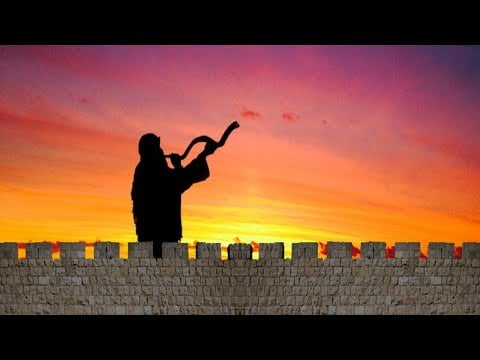
Imagine you’re living in an ancient city of a small country surrounded by other larger countries, all of whom have the ambition of spreading the borders of their respective kingdoms at the expense of your freedom.
You’ve been assigned a night watch on the city wall, and you stand on the rampart looking out on the ground below, the torches providing just enough light to make out any movement in the bushes or rustle in the trees.
What does dawn mean to the watchman?
The peace of the evening probably depends largely on how seriously you take that threat of imminent attack. Because if you don’t think it’s going to happen, you can find ways to wile away the hours, playing cards with the other guards, daydreaming about what you’ll do when you get back home, maybe even taking a quick nap if no one’s watching.
But if you believe that attack could come at any time, you’re going to experience a long, restless night, straining at every motion, trying desperately to see through the shadows, wondering why daylight is taking so long to arrive. And your one thought in all of this is simply this: “Not tonight. Not on my watch. Let me see another dawn.”
And when the dawn comes, and your relief arrives, you go home rejoicing, albeit exhausted. The other guard probably doesn’t see that walk home in the same light that you see it.
Waiting urgently for the Lord
That’s the urgency that the Psalmist is talking about when he describes what it means to wait for the Lord.
Psalm 130: “My soul waits for the Lord”
Out of the depths I cry to you, O Lord!
O Lord, hear my voice!
Let your ears be attentive
to the voice of my pleas for mercy!
If you, O Lord, should mark iniquities,
O Lord, who could stand?
But with you there is forgiveness,
that you may be feared.
I wait for the Lord, my soul waits,
and in his word I hope;
my soul waits for the Lord
more than watchmen for the morning,
more than watchmen for the morning.
O Israel, hope in the Lord!
For with the Lord there is steadfast love,
and with him is plentiful redemption.
And he will redeem Israel
from all his iniquities.
And while the illustration of the watchman isn’t supposed to be a perfect parallel to our relationship to God, it ought to make us ask a question of ourselves: How comfortable am I up on that wall? How eagerly do I await the morning?
The Christian’s desire for eternal redemption
Because in this illustration, the dawn only comes once. And the deliverance I get from being relieved of my duty isn’t a temporary reprieve; it’s an eternal rest. Because when dawn breaks and the Lord returns, the night is gone for good. The enemies aren’t coming. I will be truly delivered.
The Psalmist introduces another imperative because if the Lord doesn’t come, then the enemy will. The enemy, in this case, is my own sin, the corruption of this world that I have allowed to come into my life and separate me from the God who created me to walk upright and righteous before Him.
But the watchman doesn’t see the Lord’s coming as impending judgment and doom. He sees it as impending deliverance and mercy:
Ps 130:3–4
If you, O Lord, should mark iniquities,
O Lord, who could stand?
But with you there is forgiveness,
that you may be feared.
How badly does that watchman want the night to end, to see the dawn break? Do we desire the Lord’s return that intensely?
Are we comfortable waiting in the dark?
Maybe it’s because we don’t appreciate the danger of the darkness, that I am immune to the allures of this world and sin isn’t a threat to me. After all, don’t we sing the song “I’ll NEVER forsake my Lord.” Somehow the brethren around us who have fallen away don’t seem like a cautionary tale to us, because we see OUR faith as superior to theirs. Darkness isn’t a danger to us!
Maybe because we’re not truly convinced there IS a danger, or that dawn is even coming at all? After all, as the Psalmist writes, “In His word I hope.” If all I have is the word of God to tell me what’s out there in the darkness, maybe my attitude changes as the night drags on. Every hour of darkness that passes quietly makes me less sure that there’s anything to be vigilant about at all! Every year of my life that goes without visible, tangible evidence of God’s presence and Jesus’ impending judgment makes that idea farther and farther away. And while I may not stop believing, maybe my vigilance in remaining watchful fades with time.
And maybe, just maybe, it’s because I’ve come to enjoy the darkness a little too much. Maybe I’ve been on the wall so long that the dark seems comfortable to me. THIS is my home now, not the place of rest I’ve been promised when day breaks. Maybe I see the pleasures and pastimes I have now, tonight, in the dark, are more valuable than whatever may be coming once daylight breaks.
The transforming power of hope in Christ
Over and over through the New Testament, a Christian’s life is characterized by patiently waiting. Paul talks about the Thessalonians’ change in worldview after accepting the gospel:
1 Th 1:9–10
“…How you turned to God from idols to serve the living and true God, and to wait for his Son from heaven, whom he raised from the dead, Jesus who delivers us from the wrath to come.
It’s that hope, that desire to see the Lord, that we need to sustain us, to keep us focused on our service to God today. But that only works if it’s an overriding hope, one that sees anything other than the fulfillment of God’s promised redemption and resurrection to be empty and unfulfilling.
Ro 8:22–25
For we know that the whole creation has been groaning together in the pains of childbirth until now. And not only the creation, but we ourselves, who have the firstfruits of the Spirit, groan inwardly as we wait eagerly for adoption as sons, the redemption of our bodies. For in this hope we were saved. Now hope that is seen is not hope. For who hopes for what he sees? But if we hope for what we do not see, we wait for it with patience.
My soul waits for the Lord more than watchmen wait for morning. Does yours?